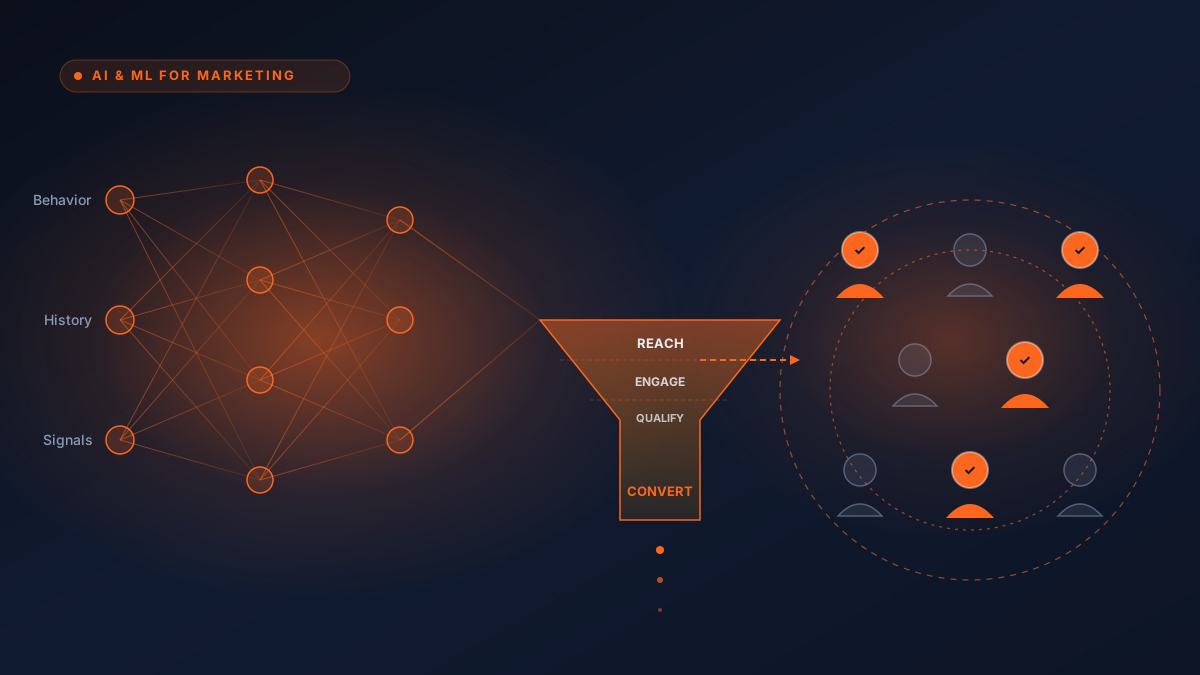
AI and ML are two powerful technologies that can be used to optimize marketing strategies. AI is a broad term referring to the ability of a machine to learn from its environment, analyze data, and make decisions independently of human input. ML is an application of AI focused on developing algorithms that enable computers to learn from past experience and make predictions about future outcomes.
By leveraging AI and ML, marketers can gain insight into customer behavior, create personalised experiences for target audiences, optimize campaigns in real time, manage large data sets with ease, and automate mundane tasks. AI and ML are also used to identify patterns in customer behavior for predictive analytics, helping marketers better understand customer needs and target advertising effectively. The end result is more personalised customer experiences, higher engagement, and stronger conversions.
Beyond insight, AI and ML solve concrete marketing problems by automating processes. AI-driven systems can automate content creation and distribution so that personalised content goes out faster and more accurately. AI-based chatbots engage customers in real-time conversation, gathering data about preferences that can be used to personalise future interactions.
In short: AI and ML help marketers identify customer preferences, automate tedious work, and create personalised experiences. As the technology continues to evolve, marketers who stay current will hold a meaningful advantage over their competitors.
The Benefits of Using AI/ML for Marketing
Using AI and ML in marketing produces benefits across the entire campaign lifecycle, from automating mundane work to surfacing insights into customer behavior. The most consistent wins are:
- Time savings. Automate content creation, distribution, segmentation, and reporting.
- Real-time engagement. AI chatbots converse with customers and capture preference data as they go.
- Behavioral insight. Identify segments and patterns in raw customer data and tune campaigns to fit.
- Predictive targeting. Anticipate what a customer needs before they ask, and put the right message in front of them at the right time.
- Higher conversions. Personalisation at scale outperforms broad-spectrum messaging in nearly every channel.
Taken together these benefits give marketers a credible path to outpace competitors who still rely on generic campaigns and rule-based segmentation.
How to Get Started with AI/ML in Marketing
Getting started with AI and ML in marketing can seem daunting, but it doesn't have to be. A pragmatic four-step path:
- Audit the goal. Pick one concrete marketing problem worth solving, better email targeting, smarter ad spend, churn prediction. Don't try to "do AI."
- Inventory the data. AI and ML are only as good as the data feeding them. Collect high-quality data, label it consistently, and organize it before you build anything.
- Pick a tool that fits. Research the available platforms and pick the smallest one that solves the problem in step 1. Experiment, then iterate.
- Measure relentlessly. Track campaign performance, compare against a non-AI baseline, and adjust. AI/ML is a feedback loop, not a one-time install.
It's also important to invest time in understanding the data privacy regulations that apply to your business and how they affect AI use in marketing. Done well, the result is personalised customer experiences that produce real engagement and conversion lift. Done poorly, you risk over-fitting to noisy data, alienating customers, or running into compliance trouble.
Examples of Companies Successfully Using AI/ML for Marketing
AI and ML have become essential tools for successful marketers. A few well-known examples:
- Netflix uses AI and ML to recommend content based on user preferences and viewing history.
- Amazon leverages AI/ML to make product recommendations based on previous purchases and browsing patterns.
- Uber uses AI/ML to track customer behavior, optimize routes for drivers, and recommend destinations based on travel patterns.
The common thread: each of these businesses combines high-quality first-party data with continuous experimentation. Success comes from the data discipline as much as the algorithm.
Challenges to Consider When Implementing AI/ML
AI/ML in marketing is powerful, but there are real risks to plan for:
- Bias in training data. Algorithms are typically trained on data sets that may contain bias or other errors. Audit the data before training the model.
- Ethical and privacy implications. Data privacy, algorithmic fairness, and consumer trust all matter, and increasingly carry regulatory consequences.
- Team composition. A skilled data scientist is essential, but so are an experienced product manager and a marketer who understands the campaigns the model is meant to serve. Solo data-science efforts rarely ship.
- Operational drift. Models that performed well at launch can degrade as customer behavior changes. Plan for monitoring and retraining from day one.
With the right plan in place, marketers can leverage AI and ML responsibly, anonymising data, building secure systems, monitoring for bias, and treating model output as a recommendation rather than a verdict.
Final Thoughts, What's Next for AI/ML in Marketing
The use of AI/ML in marketing is growing rapidly, and businesses that stay ahead of the curve will reap the rewards. As models continue to improve and more data becomes available, marketers will be able to build even more personalised experiences, optimize product recommendations, and develop predictive analytics models that keep them a step ahead of their competitors.
AI/ML in marketing is here to stay. Businesses that build the right strategy and team, and treat data as a first-class asset, will turn these tools into a durable competitive advantage.
References
- Nair, K., & Gupta, R. (2021). Application of AI technology in modern digital marketing environment. World Journal of Entrepreneurship, Management and Sustainable Development, 17(3), 318-328.
- Saura, J. R., Ribeiro-Soriano, D., & Palacios-Marqués, D. (2021). Setting B2B digital marketing in artificial intelligence-based CRMs: A review and directions for future research. Industrial Marketing Management, 98, 161-178.
- Van Esch, P., & Stewart Black, J. (2021). Artificial intelligence (AI): revolutionizing digital marketing. Australasian Marketing Journal, 29(3), 199-203.