As the world of marketing becomes increasingly complex, so too do the tools and techniques needed to reach customers effectively. Social network analysis is one such tool that is gaining popularity among marketers looking to better understand and target their audience.
Companies should use social media to advertise instead of general website ads. In this post we address the significance of social networks in online marketing and provide social network analysis (SNA) techniques to build a targeted marketing strategy for any product launch, identifying the best channels for reaching a target market and the key influencers that reduce advertising costs while maintaining large-scale reach.
Digital targeted marketing and advertising is a form of online marketing that uses web-based technologies to reach potential customers in a more specific and personal way. By targeting a specific audience with relevant ads, businesses can more effectively draw in new customers and conversions. There are a number of different ways to target an audience online, including through demographics, location, interests, and friend graphs. Digital targeted marketing can be extremely effective, but it is most powerful when used in conjunction with other forms of marketing (Wind & Mahajan, 2002).
Social network analysis, on the other hand, is the process of mapping out relationships between individuals and groups. It can be used to identify influencers, measure reach, and track how information flows through a network. This information can be leveraged for marketing in many ways: targeting ads more effectively, identifying potential brand ambassadors, monitoring brand sentiment, or modeling how a campaign is likely to spread (Butts, 2008).
Social network data can be used to create many types of graphs, connectivity graphs (who is connected to whom), trail graphs (the path a user took through a network), and co-occurrence graphs (who interacts with whom most often). These graphs can be used to study network behavior and identify areas of improvement (Das et al., 2018).
Collecting social network data can be a valuable way to gain insight into people's behaviors and preferences. Before starting any data-collection project it's important to (1) clearly define the scope and the kind of data you hope to collect, (2) decide on a collection method appropriate for the objectives, and (3) consider how to protect the privacy of those whose data is used. For this study we used data published by Stanford University, which has already been cleaned and anonymised for SNA research.
One of the most popular applications of SNA is marketing, the focus of this post. By understanding the relationships between individuals, businesses can more effectively target their messages and tailor content to specific groups. Facebook uses SNA to map user interests and provide targeted ads. Twitter has used SNA to study how information about brands and products spreads. By understanding how information flows through social networks, businesses can promote products and services far more effectively (Doyle, 2007).
As businesses look for ways to connect with their target audiences, SNA has emerged as a powerful tool for targeted marketing, mapping and analyzing the relationships between individuals or groups in order to identify influencers and key opinion leaders. By understanding the structure of social networks, businesses can reach their target audiences through word-of-mouth marketing and other forms of social influence, identify new customer segments, and understand how information flows within a given network (Boon-Long & Wongsurawat, 2015).
SNA also has limitations. It often relies on self-reported data which can be unreliable, samples are sometimes small and produce skewed results, and it is largely static, strong at describing current relationships but weaker at predicting future change. Given these limitations, SNA should be used in conjunction with other research methods to produce the most accurate and complete picture (Sheshasaayee & Jayamangala, 2017).
In short: when used correctly, social network analysis provides valuable insights into human behavior that can be leveraged to increase sales, by understanding how people are connected, marketers can target advertising and messages far more effectively.
Data Description
The Facebook ego network data set is a collection of anonymised Facebook user networks made available for academic research. The dataset excludes user profile attributes and content interactions for privacy reasons (McAuley & Leskovec, 2012). It is a CSV file with two columns and 88,235 rows: the first column is the source node, the second is the "friend" node. Nodes are numbered 0-4038 instead of using real names.
Data Processing & Analysis
To analyze the Facebook ego network in Python we used networkx, matplotlib, and pandas. Visualizing the full network produces a dense ball of 4,039 anonymised nodes connected by 88,234 edges, far too dense to read at a glance, which is exactly why centrality measures matter.
The first goal of this analysis is to identify key players in the network for digital advertising. Calculating measures of centrality, degree, betweenness, and eigenvector, gives us a structured way to understand who matters most.
Degree Centrality
Degree centrality is a measure of node importance: the number of connections a node has to other nodes in the network. Nodes with high degree centrality are influential in the spread of information because they reach many other nodes directly. In SNA, degree centrality is often used to identify opinion leaders or "super-spreaders" of information, and to find cliques, groups of closely connected individuals, within a network (Das et al., 2018).
Most nodes in the dataset have a degree score below 300. Filtering for nodes scoring above 300 surfaces the network's true influencers:
| Node | Degree |
|---|---|
| 107 | 1,045 |
| 1684 | 792 |
| 1912 | 755 |
| 3437 | 547 |
| 0 | 347 |
Betweenness Centrality
Betweenness centrality is the number of shortest paths between two nodes that pass through a given node. Nodes with high betweenness are often referred to as "bridges" or "hubs", they play a critical role in communication and information flow. Betweenness centrality is useful for identifying potential bottlenecks and unusual communication patterns such as cliques and backbones (Das et al., 2018).
The vast majority of nodes scored below 0.1 on betweenness; the top six are:
| Node | Betweenness |
|---|---|
| 107 | 0.48 |
| 1684 | 0.33 |
| 3437 | 0.23 |
| 1912 | 0.22 |
| 1085 | 0.14 |
| 0 | 0.14 |
Eigenvector Centrality
Eigenvector centrality is based on the principle that a node is more important if it is connected to other important nodes. The eigenvector centrality of a node is essentially the influence it has on its neighbors. Nodes with high eigenvector centrality are influential within the network; nodes with low eigenvector centrality are not (Das et al., 2018).
The eigenvector distribution is dramatically more concentrated than degree or betweenness, one node clearly stands apart:
| Node | Eigenvector |
|---|---|
| 1912 | 0.09 |
One of the ultimate goals of this study is to minimize advertising cost, which is why we exclude many of the lower-scoring nodes. The remaining nodes show importance precisely because the majority are connected to the influential nodes in the network.
Results
- From degree centrality, nodes 107, 1684, 1912, 3437, and 0 are the most important nodes in the network.
- From betweenness centrality, nodes 107, 1684, 3437, 1912, 1085, and 0 are the most important.
- From eigenvector centrality, node 1912 is the most important node in the network.
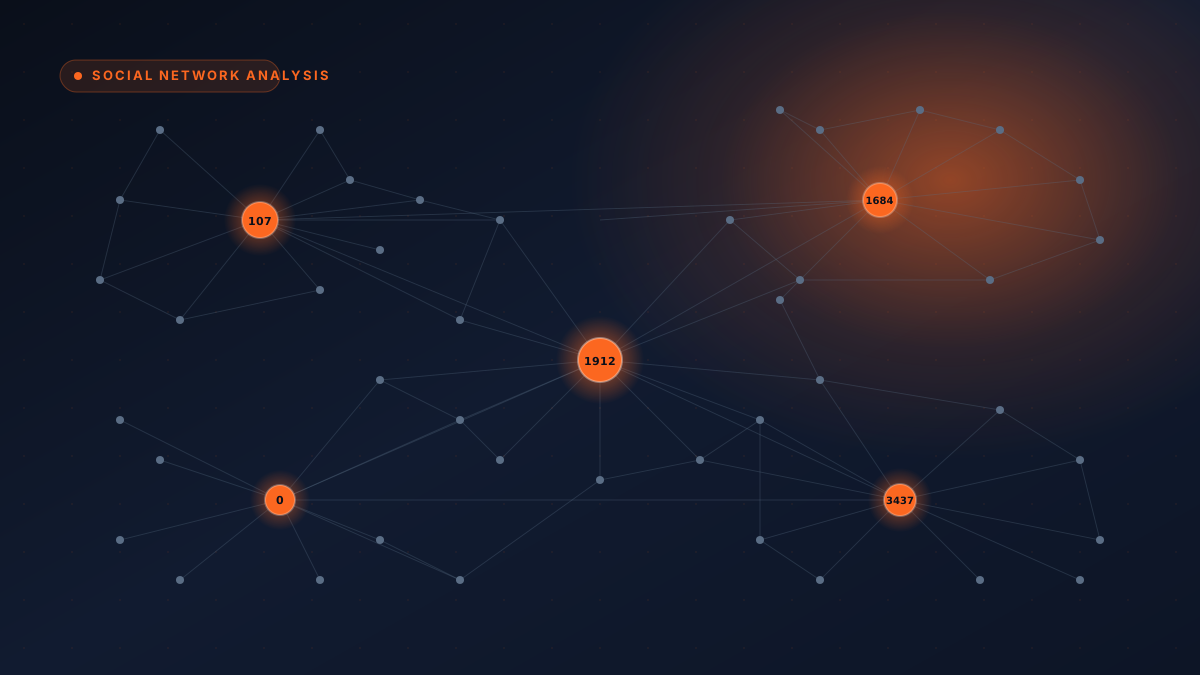
Combining all three measures, nodes 107, 1684, 1912, 3437, and 0 are the key players, the "supernodes", in this Facebook network. They are essential to keeping the network cohesive and functioning. Without them, the number of connections between users would drop dramatically and information would propagate much more slowly.
Why does this matter for a marketer? Because targeted ads are only as effective as the audience definition behind them. If your business sells products that appeal to parents you can target users in parenting groups; if your business sells fitness products you can target users in fitness groups. Centrality measures let you go further and identify the specific individuals who connect those groups, the people whose endorsement reaches everyone else.
The Cost Argument
On average, Facebook ads cost around $12 per impression or $0.97 per click, and serve general ads that don't target the specific audience you need (WebFX, 2022). Influencers with 1,000-10,000 followers cost $25-$250 per ad (Geyser, 2022) and tend to produce stronger engagement than generic web ads, followers see them as more credible, the medium is more interactive, and an influencer's audience is often more diverse than a single website's.
Reaching ~4,000 people in this particular network through the five identified influencers would cost roughly $1,250. Reaching the same 4,000 people through paid clicks would cost roughly $3,880.
That is a cost reduction of more than 60%.
Summary & Conclusion
Using social network analysis to identify key nodes is an effective strategy for businesses that want to market their products and services successfully. Power users and super-connectors are typically highly active on social media, maintain large networks of friends and followers, and frequently share content with those networks. As a result, they have the potential to reach a large number of people with marketing messages at a fraction of the cost of generic paid advertising.
To use SNA effectively in marketing, businesses need a working understanding of social network structure and access to data describing those networks. Once the key nodes have been identified, targeted outreach to those nodes consistently outperforms broad-spectrum paid advertising, both in cost and in conversion quality.
References
- Boon-Long, S., & Wongsurawat, W. (2015). Social media marketing evaluation using social network comments as an indicator for identifying consumer purchasing decision effectiveness. Journal of Direct, Data and Digital Marketing Practice, 17(2), 130-149.
- Butts, C. T. (2008). Social network analysis with sna. Journal of Statistical Software, 24, 1-51.
- Das, K., Samanta, S., & Pal, M. (2018). Study on centrality measures in social networks: a survey. Social Network Analysis and Mining, 8(1), 1-11.
- Doyle, S. (2007). The role of social networks in marketing. Journal of Database Marketing & Customer Strategy Management, 15(1), 60-64.
- Geyser, W. (2022, August 1). Influencer rates: How much do influencers really cost in 2022? Influencer Marketing Hub.
- McAuley, J., & Leskovec, J. (2012). Learning to discover social circles in ego networks. NIPS.
- Sheshasaayee, A., & Jayamangala, H. (2017). A study on the new approaches for social network based recommendations in digital marketing. 2017 International Conference on Innovative Mechanisms for Industry Applications (ICIMIA).
- WebFX. (2022, August 12). How much does Facebook advertising cost in 2022?
- Wind, J., & Mahajan, V. (2002). Digital marketing. Symphonya. Emerging Issues in Management, (1), 43-54.